Practice Note 2
How We Practice Matters
Reflections on strengthening how we practice, learn, and share what we know
About this practice note: This reflection draws on evaluation work I contributed to through The Open Canopy in partnership with the CDC National Asthma Control Program. The reflections and interpretations are my own and should not be understood as representing the views of The Open Canopy or the organizations involved.
Who we are shapes how we evaluate.
The Challenge
The CDC National Asthma Control Program (NACP) had long supported state and territorial asthma programs with practical resources for planning, conducting, and using evaluation, including Learning & Growing through Evaluation. As the evaluation field and practitioners’ needs evolved, NACP saw an opportunity to update these resources to reflect contemporary evaluation practice.
The update also surfaced a broader need. Practitioners needed guidance not only on what to do in an evaluation, but on how to practice evaluation well—with attention to context, culture, relationships, judgment, and reflection. This led to Planting the Seeds for High-Quality Program Evaluation in Public Health, an e-text designed to connect practical public health evaluation with the theories, competencies, values, and professional practices of the broader evaluation field.
NACP also recognized that valuable knowledge generated through practice was not always reaching the broader field. Sharing that knowledge could help other practitioners learn from experience while giving researchers greater insight into what was happening in the field and where further inquiry might be useful.
Learning Question
One Response: Strengthening Capacity in Different Ways
There was no single strategy for addressing this question. Instead, NACP developed an approach intentionally aligned with its specific context, needs, and objectives. I was fortunate to be part of the team that helped implement it.
The team updated Learning & Growing through Evaluation to strengthen practical guidance for planning, conducting, and using evaluation. We developed Planting the Seeds for High-Quality Program Evaluation in Public Health, an e-text that connected that practical guidance more explicitly with evaluation theory and professional practice. NACP also created opportunities for practitioners to learn about the publication process and provided individualized support to grantees interested in sharing knowledge generated through their work with the broader field.
Together, these efforts addressed two interconnected aspects of evaluation capacity: the capacity to practice evaluation well and the capacity to contribute what is learned through practice to a broader body of knowledge.
My Role
- Contributing to the update of the Learning & Growing modules
- Co-authoring Planting the Seeds, including content addressing broader competencies involved in how evaluation is practiced
- Providing individualized coaching and technical assistance to grantees interested in publishing their work
Beyond the Steps: The “How” of Evaluation Practice
A key feature of the Learning & Growing modules was CDC’s 1999 Framework for Program Evaluation in Public Health. Its six steps provided practitioners with a practical structure for understanding the activities involved in implementing an evaluation—from engaging stakeholders and describing the program to gathering evidence, drawing conclusions, and supporting use.
But knowing what activities are involved in an evaluation is different from knowing how to carry them out well. High-quality evaluation also depends on how evaluators navigate context, culture, relationships, their own assumptions, and the choices they make throughout the process.
The Enhanced CDC Framework, introduced in Planting the Seeds, made this distinction visible. At its center were the steps and standards of CDC’s existing framework. Surrounding them were four dimensions of professional practice: critical reflection, interpersonal competence, cultural responsiveness, and situational awareness.
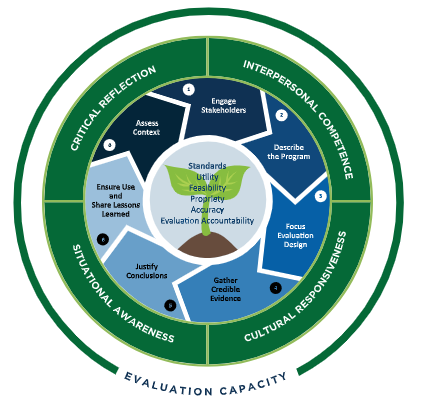
As we wrote in the e-text, our ability as evaluators to be aware of ourselves, others, and the broader environments in which we work—the how of our practice—is as important as carrying out the technical steps of an evaluation.
That distinction has stayed with me. A framework can tell us to engage people, gather credible evidence, justify conclusions, and support use. But how we carry out those steps matters. We have to navigate relationships and power, understand and respond to changing contexts, work across different perspectives and experiences, examine our own assumptions, and make thoughtful choices about evidence and interpretation.
Technical competence is necessary, but it isn’t sufficient.
A note on the framework: Planting the Seeds was developed using CDC’s 1999 Framework for Program Evaluation in Public Health. CDC published a revised framework in 2024. The discussion above reflects the framework used when the e-text was developed. The Critical Reflection in Practice resource discussed below uses the 2024 framework.
Critical Reflection: Examining How We Practice
Of the four dimensions in the enhanced framework, critical reflection is the one I worked on most directly—and the one that has continued to shape my own thinking about evaluation practice.
Critical reflection starts with a deceptively simple premise: who we are shapes how we evaluate.
We don’t leave our histories, worldviews, values, beliefs, experiences, and assumptions at the door when we begin an evaluation. They shape what we notice and overlook, which questions seem important, how we relate to others, what we consider credible evidence, and how we interpret what we find.
Following technical procedures does not make those influences disappear. Our technical choices are themselves shaped by how we understand the world and the work in front of us. Critical reflection asks us to bring those influences into view so we can examine how they may be shaping our practice.
I’ve continued exploring these ideas in my own work through a framework I call Ways of Knowing in Evaluation, which considers four dimensions of knowing that support evaluation practice: knowing self, knowing others, knowing the discipline, and knowing the common good and equity. That framework extends beyond the CDC materials, but it grows from the same interest in examining the influences we bring to our practice.
Critical Reflection in Practice
Reflection is often treated as a deliberate activity—something we make time for in a debrief or lessons-learned session. But reflection is also something we do naturally as part of everyday experience. We are continually making sense of what happens, reconsidering our understanding, revisiting decisions, and adjusting how we think or act. In evaluation, that means reflection can occur throughout the work, whether or not we have formally created a space for it.
Critical reflection asks something more of us. It means making that thinking more explicit and examining it. What assumptions am I making? Where did they come from? Are they justified? How are they affecting my decisions or relationships? Are they supporting the principles I want to uphold in my practice—or getting in the way?
Without that scrutiny, reflection can reinforce existing biases, create certainty where it isn’t warranted, limit alternative explanations, or prevent us from changing our practice.
Critical reflection also intersects with the other dimensions of the enhanced framework. Practicing cultural responsiveness requires awareness of the cultural lenses through which we interpret another person’s or community’s context. Interpersonal competence requires us to consider how we present ourselves, relate to others, and navigate differences in perspective and power. Situational awareness requires us to notice changes around us and question whether our assumptions or approach still fit the context.
In practice, these dimensions don’t operate independently. They inform one another.
A Resource for Practice
I’ve developed Critical Reflection in Practice: Pause Points for Thinking Critically About How We Practice Evaluation as one way to put these ideas into practice.
The pause points are organized around the six steps in CDC’s 2024 Program Evaluation Framework and informed by its three cross-cutting actions: Engage Collaboratively, Advance Equity, and Learn From and Use Insights. The published framework positions these actions across all six steps and emphasizes learning throughout an evaluation about both the program and the evaluation itself.
The pause points aren’t intended to prescribe what practitioners should reflect on. They’re starting points for thinking. Use what is helpful, modify the prompts, add your own, or leave some aside depending on your evaluation and context.
Explore Critical Reflection in Practice →
The reflective prompts in this resource are my own and are not part of CDC’s Program Evaluation Framework.
Creating Space for Reflection
Critical reflection is something we should practice intentionally, but we can also think about the conditions that allow it to emerge naturally. Sometimes, those conditions can arise through other parts of the work—including the process of preparing to share what we’ve learned.
NACP’s publication-support strategy offers one example. Bringing practitioners together to think about publishing their work introduced them to the publication process and created opportunities to consider how knowledge generated through their work might be shared with others.
Preparing to share their work also required practitioners to step back from day-to-day implementation and think about how to explain the work to someone outside it. That meant revisiting important decisions, considering what they had learned, and identifying what might be useful to others. Conversations with other practitioners could also introduce questions or perspectives that prompted them to reconsider how they understood their own experience.
I don’t know whether practitioners experienced these conversations as critical reflection. But looking back, I can see how a process like this could create some of the conditions that support it: time to step outside the work, make thinking more explicit, encounter other perspectives, and reconsider one’s own understanding.
This has changed how I think about sharing knowledge. Sharing doesn’t have to be something that happens only after learning. The process of preparing to share what has been learned can itself create opportunities for further learning and reflection.
It also reinforced something I now think is important for capacity strengthening: reflection doesn’t have to depend entirely on an individual’s inclination to reflect. We can intentionally create structures, processes, and spaces that invite it.
And when what emerges from that reflection is shared, its value can extend further. Practice-generated knowledge can help other practitioners think differently about their own work and give researchers greater visibility into what is happening on the ground—potentially informing new questions and future research.
What I Took From This Work
Capacity strengthening needs to be intentional and responsive to context. There isn’t one package of evaluation capacity strengthening that will be useful everywhere. The starting point is understanding what people already know, what they need, what is working well, what is getting in the way of good practice, and the conditions in which they are working. Different needs may call for different responses—from practical tools and conceptual resources to coaching, peer learning, or protected space for reflection.
Practitioners need guidance on the “how,” not only the “what.” Methods, standards, and frameworks are essential. But practicing evaluation well also requires us to understand and respond to context, examine our assumptions, navigate relationships and power, work across different perspectives and experiences, and adapt as circumstances change. Capacity strengthening should support these dimensions of practice alongside technical knowledge and skills.
Strengthening practice and strengthening the knowledge base are connected. Practitioners don’t simply consume evaluation knowledge; they generate it through their work. Creating opportunities to reflect on and share that knowledge can support practitioners’ own learning while allowing what they learn to travel beyond an individual program. Practice-generated knowledge can inform other practitioners, surface questions for researchers, and contribute to a stronger exchange between research and practice. But individual capacity isn’t enough. People also need the time, organizational support, and opportunities to reflect on, use, and share what they know.
Ultimately, this experience broadened how I think about evaluation capacity. Strengthening evaluation capacity isn’t simply about helping people do evaluation. It’s about strengthening the knowledge, skills, reflective practices, relationships, and conditions that help people practice it well—and creating opportunities for what they learn through practice to be shared.
Sources & Resources
- Learning & Growing through Evaluation: Modules 1–6
- Planting the Seeds for High-Quality Program Evaluation in Public Health
- Framework for Program Evaluation in Public Health (1999)
- CDC Program Evaluation Framework, 2024