Framework
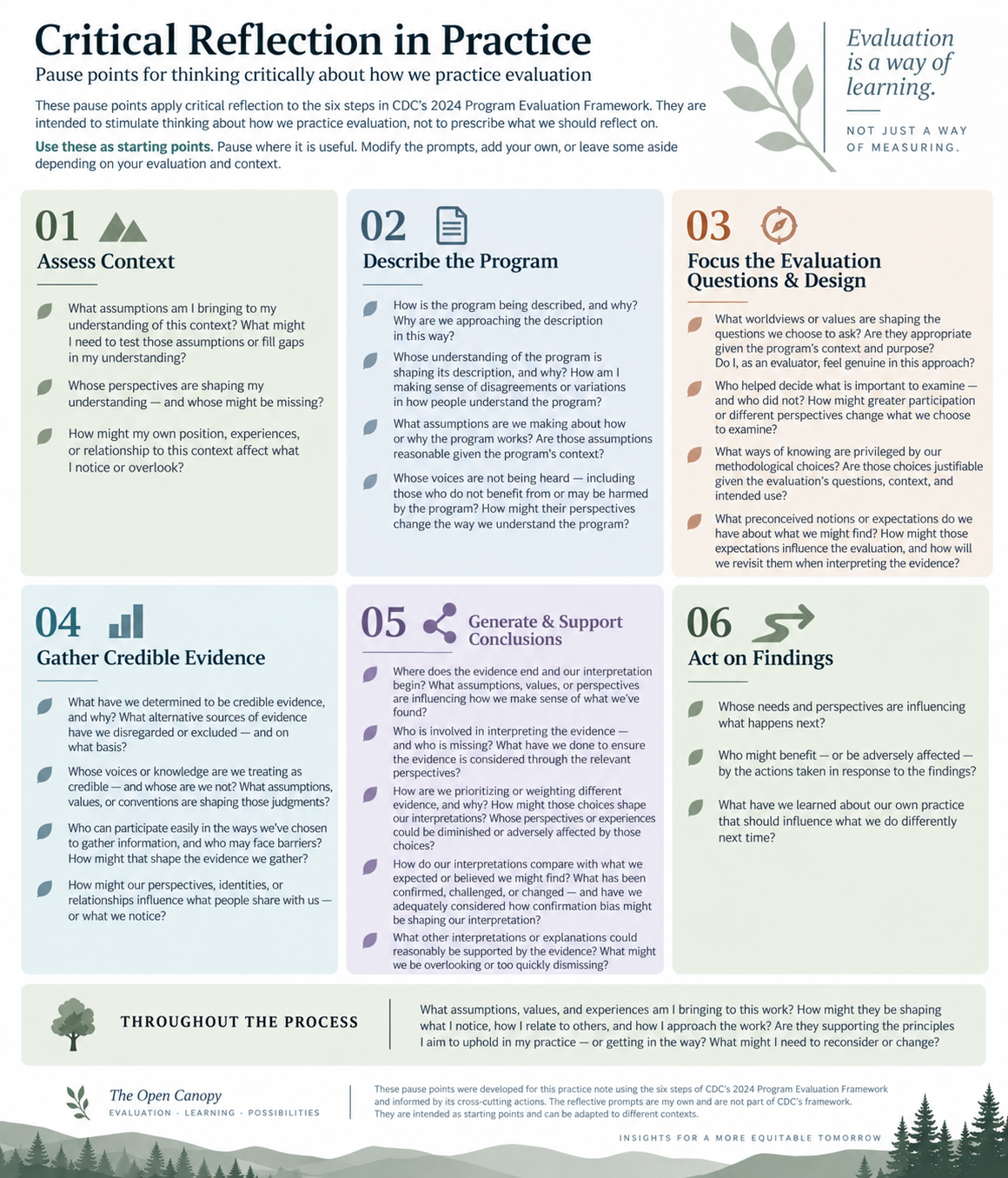
Critical Reflection in Practice
Pause points for thinking critically about how we practice evaluation.
Critical reflection asks us to examine the assumptions, values, experiences, and perspectives we bring to evaluation — and how they may be influencing the choices we make throughout the work.
The pause points below are organized around the six steps in CDC’s 2024 Program Evaluation Framework and informed by its cross-cutting actions: Engage Collaboratively, Advance Equity, and Learn From and Use Insights.
Use them as starting points for thinking. Modify them, add your own, or leave some aside depending on your evaluation and context.
Assess Context
- What assumptions am I bringing to my understanding of this context? What might I need to test those assumptions or fill gaps in my understanding?
- Whose perspectives are shaping my understanding — and whose might be missing?
- How might my own position, experiences, or relationship to this context affect what I notice or overlook?
Describe the Program
- How is the program being described, and why? Why are we approaching the description in this way?
- Whose understanding of the program is shaping its description, and why? How am I making sense of disagreements or variations in how people understand the program?
- What assumptions are we making about how or why the program works? Are those assumptions reasonable given the program’s context?
- Whose voices are not being heard — including those who do not benefit from or may be harmed by the program? How might their perspectives change the way we understand the program?
Focus the Evaluation Questions and Design
- What worldviews or values are shaping the questions we choose to ask? Are they appropriate given the program’s context and purpose? Do I, as an evaluator, feel genuine in this approach?
- Who helped decide what is important to examine — and who did not? How might greater participation or different perspectives change what we choose to examine?
- What ways of knowing are privileged by our methodological choices? Are those choices justifiable given the evaluation’s questions, context, and intended use?
- What preconceived notions or expectations do we have about what we might find? How might those expectations influence the evaluation, and how will we revisit them when interpreting the evidence?
Gather Credible Evidence
- What have we determined to be credible evidence, and why? What alternative sources of evidence have we disregarded or excluded — and on what basis?
- Whose voices or knowledge are we treating as credible — and whose are we not? What assumptions, values, or conventions are shaping those judgments?
- Who can participate easily in the ways we’ve chosen to gather information, and who may face barriers? How might that shape the evidence we gather?
- How might our perspectives, identities, or relationships influence what people share with us — or what we notice?
Generate and Support Conclusions
- Where does the evidence end and our interpretation begin? What assumptions, values, or perspectives are influencing how we make sense of what we’ve found?
- Who is involved in interpreting the evidence — and who is missing? What have we done to ensure the evidence is considered through the relevant perspectives?
- How are we prioritizing or weighting different evidence, and why? How might those choices shape our interpretations? Whose perspectives or experiences could be diminished or adversely affected by those choices?
- How do our interpretations compare with what we expected or believed we might find? What has been confirmed, challenged, or changed — and have we adequately considered how confirmation bias might be shaping our interpretation?
- What other interpretations or explanations could reasonably be supported by the evidence? What might we be overlooking or too quickly dismissing?
Act on Findings
- Whose needs and perspectives are influencing what happens next?
- Who might benefit — or be adversely affected — by the actions taken in response to the findings?
- What have we learned about our own practice that should influence what we do differently next time?
Throughout the Process
What assumptions, values, and experiences am I bringing to this work? How might they be shaping what I notice, how I relate to others, and how I approach the work? Are they supporting the principles I aim to uphold in my practice — or getting in the way? What might I need to reconsider or change?
These pause points were developed using the six steps of CDC’s 2024 Program Evaluation Framework and informed by its cross-cutting actions. The reflective prompts are my own and are not part of CDC’s framework. They are intended as starting points and can be adapted to different evaluations and contexts.