Framework
Ways of Knowing in Evaluation
What we know, how we know, and why it matters in practice
Evaluation practice draws on more than methods and technical expertise. We also bring our experiences, values, relationships, judgments, and understandings of the world to the work.
Start With a Moment From Your Practice
Think about a time in your evaluation practice when you weren’t quite sure what to do.
Maybe two people understood the program very differently. The evidence pointed in different directions. A method that looked right on paper didn’t seem to fit the context. Someone challenged an interpretation you thought was sound. Or you had to make a judgment when there wasn’t an obvious “right” answer.
Put yourself back in that moment for a minute. How did you figure out what to do?
- What helped you make sense of the situation?
- What knowledge or experience did you rely on?
- What assumptions, values, or feelings influenced your thinking?
Chances are, there wasn’t a single source of knowledge guiding you. You were bringing together what you’d learned formally with what you’d learned through experience, what you understood about the people and context, your own values and perspectives, and perhaps things that were harder to name.
When the methods or the textbook don’t tell us exactly what to do, what knowledge helps us decide?
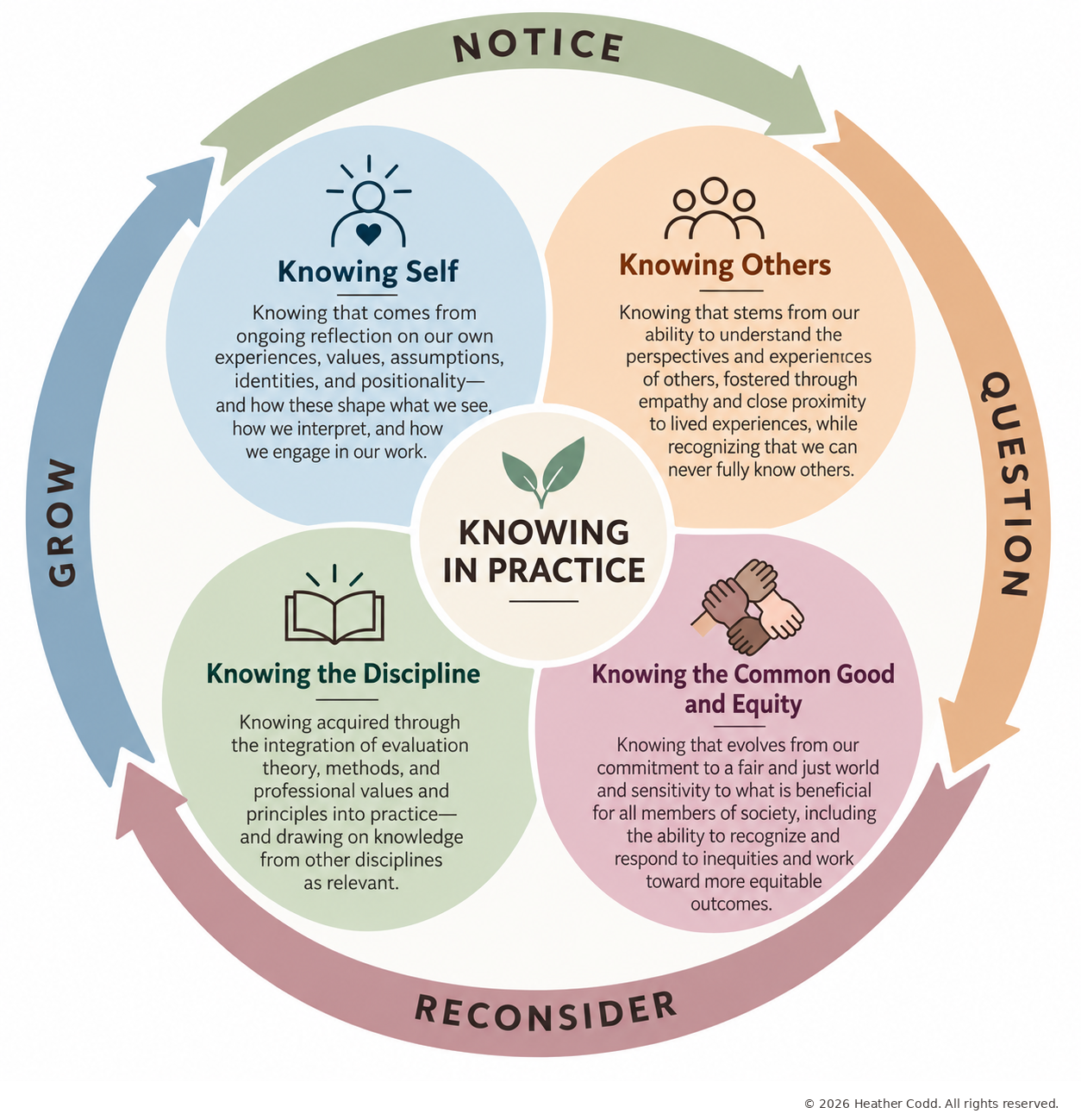
I’ve spent years thinking about this question, and I’m still thinking and learning about it. Through reading, conversations with other evaluators, my own practice, and a lot of reflection, I’ve come to think about four interrelated ways of knowing: Knowing Self, Knowing Others, Knowing the Discipline, and Knowing the Common Good & Equity.
These ways of knowing offer one lens for exploring the knowledge that underlies evaluation practice. At any given moment, we may draw on several of them at once as we make sense of what is happening, make judgments, relate to others, and decide what to do next.
I don’t see these four ways as the final word. Other evaluators may recognize ways of knowing in their own practice that aren’t captured here. My hope is that this framework gives us a place to start noticing, questioning, and talking about something we don’t always make explicit: how we know what we know when we practice evaluation.
Four Reflective Actions
Surrounding the four ways of knowing are four reflective actions: Notice, Question, Reconsider, and Grow. They describe how we can engage with our ways of knowing, rather than simply relying on them.
- Notice what we are drawing on, what we are seeing and sensing, and what may be shaping our attention.
- Question where that knowledge comes from, what it might leave out, and whose perspectives are present or missing.
- Reconsider our interpretations, judgments, and choices in light of what we have noticed and questioned.
- Grow by carrying what we learn forward into our practice, our relationships, and our ongoing learning.
These actions are interconnected and iterative, not a prescribed sequence. We may move between them in any order, return to them again and again, or engage several at once as our understanding deepens.
Knowing Self
Knowing that comes from ongoing reflection on our own experiences, values, assumptions, identities, and positionality. It involves looking inward to understand what shapes our perspectives, being present to recognize our emotions and reactions in the moment, and looking outward to consider how these influence our interpretations, interactions, and engagement with others.
We don’t enter an evaluation as neutral instruments. Our experiences, identities, assumptions, values, and perspectives influence what we notice, how we understand a situation, how we relate to others, and the judgments we make.
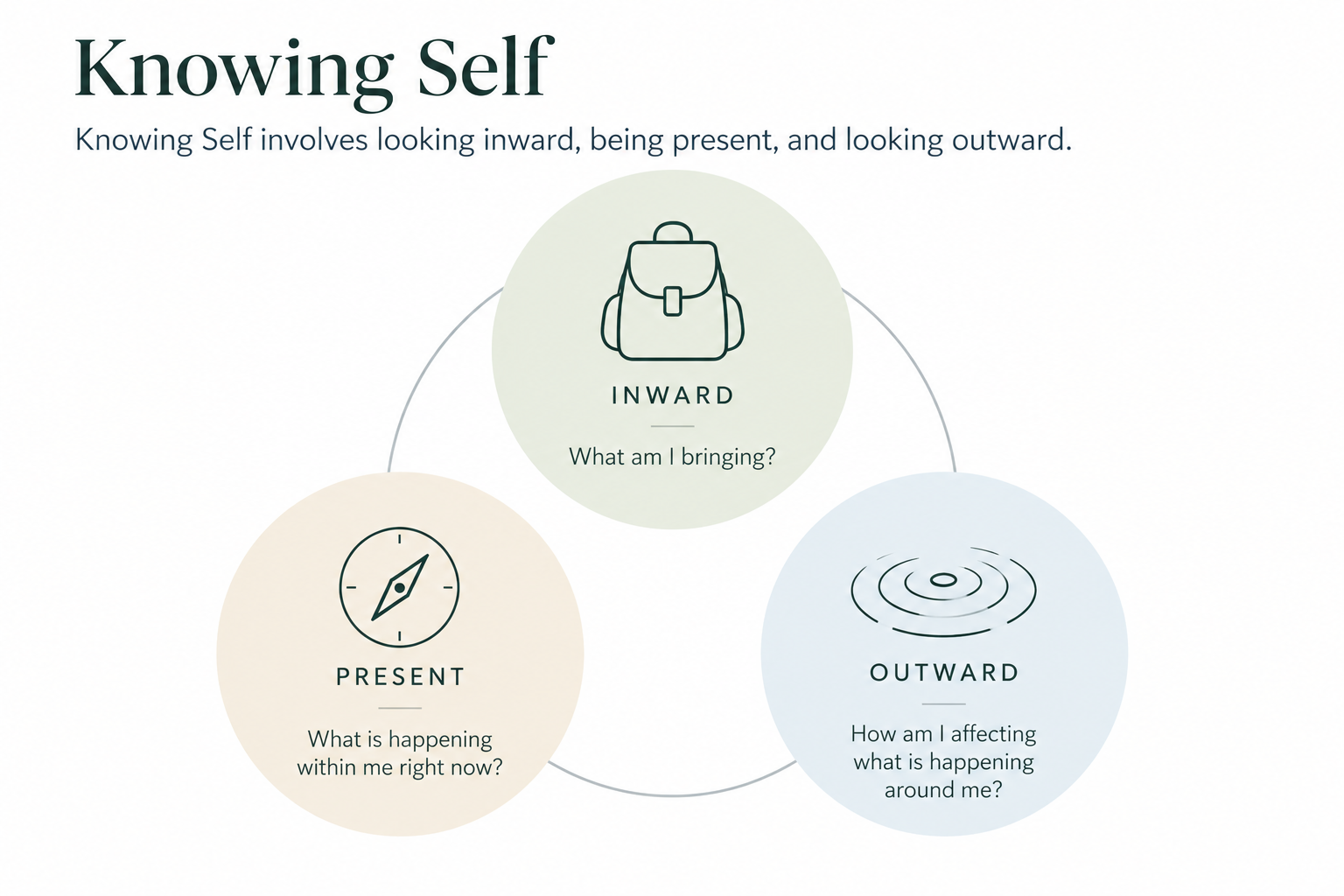
Knowing Self involves looking inward, being present, and looking outward. We look inward to understand the histories, experiences, values, assumptions, and positionalities we bring to our work. We stay present to notice our emotions, reactions, intuitions, and uncertainties as they arise. And we look outward to consider how we are presenting ourselves, how our identities and roles affect our relationships with others, and how our presence and actions may be influencing the evaluation itself.
Knowing Others
Understanding other people’s experiences and viewpoints with empathy and respect, while embracing the ambiguity that results from our inability to fully know anyone else’s world.
Evaluation is relational. We try to understand the experiences, histories, interests, perspectives, and ways of making sense of the world of the people connected to our work.
But Knowing Others isn’t about assuming we can fully understand someone else’s experience. It requires both empathy and humility: working to understand another person’s perspective while recognizing the limits of our own understanding.
Knowing the Discipline
Drawing on our training, methods, theories, professional standards, values, and principles to do the work well.
This is perhaps the most familiar form of evaluator knowledge. It includes research and evaluation methods, evaluation theory, ethics, standards, principles, and other knowledge developed within the profession.
Knowing the Discipline gives us an essential foundation for practice. But evaluation isn’t simply a matter of applying that knowledge according to a prescribed set of steps. We bring disciplinary knowledge into conversation with what we understand about ourselves, other people, and the situation in front of us.
Knowing the Common Good & Equity
Paying attention to fairness: who benefits, who’s left out, and what would make things better for everyone.
Evaluation involves choices about what matters, whose perspectives receive attention, what constitutes credible evidence, and what consequences deserve consideration.
Knowing the Common Good & Equity asks us to look beyond the immediate evaluation and consider its relationship to fairness, power, inequity, and people’s well-being. It involves both awareness and action: recognizing conditions that produce inequity and considering how our practice might contribute to—or work against—the common good.
We Draw on Different Ways of Knowing at Once
These aren’t four boxes we move through one at a time. They interact.
Imagine deciding whether a particular source of evidence should be considered credible. You might draw on Knowing the Discipline to consider methodological quality, Knowing Others to understand what others consider sound and meaningful, Knowing Self to question your own assumptions about credibility, and Knowing the Common Good & Equity to consider whose knowledge might be privileged or excluded.
That interaction matters because evaluation practice happens in messy, complex contexts. We have to attend to relationships, different perspectives, context, evidence, consequences, and competing demands, often while navigating ambiguity about what things mean or what to do next. And because every evaluation unfolds in a different context, what worked in the last evaluation may not work in this one. Different ways of knowing help us manage that complexity and ambiguity and make judgments about what the situation in front of us requires.
How we know shapes how we practice.
But that is also why our ways of knowing deserve our attention. They help us navigate complexity and ambiguity, but they can also shape—and sometimes constrain—what we notice, how we interpret what is happening, and the choices we make.
Ways of knowing are essential to practice, but they are not infallible.
Becoming more aware of our ways of knowing gives us an opportunity to notice, examine, challenge, and expand them. Critical reflection can help us examine our assumptions, values, and perspectives. Dialogue and feedback can surface things we may not recognize ourselves. Seeking different perspectives and forms of knowledge can challenge what we think we know. And surprise, discomfort, disagreement, or something that simply doesn’t work as expected can signal that there may be something worth examining more closely.
The point isn’t to eliminate the influences we bring to our practice. It’s to become more mindful of them—and more willing to question, expand, or reconsider what we think we know.
Return to Your Moment
Think again about the situation you recalled at the beginning.
- What knowledge were you relying on?
- Which of these ways of knowing can you recognize? What else were you drawing on that isn’t captured here?
And perhaps most importantly: how did your ways of knowing help you—and how might they have limited you?
That, for me, is where this framework becomes useful. Not as the answer to how evaluators know, but as an invitation to become more aware of our own knowing, to question it, and to learn from one another about the many ways we come to know in practice.