Framework
Organizational Capacity for Learning
An emerging framework
As an evaluation capacity strengthening practitioner and evaluator, much of my work has focused on helping people and organizations strengthen their ability to use evaluation to generate evidence that will help them better understand their work and make strategic decisions.
Like many people working in my field, I spend considerable time with partners clarifying the underlying logic of programs, identifying the questions that matter most, strengthening the knowledge and capabilities needed to engage in evaluation, and selecting and implementing rigorous methods to generate sound evidence when it is needed.
But the clincher, really, is what happens after the evidence is generated.
At this point in my career, I’ve seen a variety of scenarios. I’ve worked with organizations that readily welcome new evidence into conversations about strategy and practice, and others where equally useful evidence struggles to get through the front door. I’ve seen organizations genuinely wrestle with findings—even those that challenge what they thought was true—and others where reconsidering their assumptions seemed almost out of reach.
For a long time, I thought about these differences primarily in terms of evaluation capacity, particularly an organization’s capacity to engage with and use evaluative evidence. That made sense given my work in evaluation capacity strengthening. But over time, I’ve started wondering whether what I was observing was broader than evaluation.
Evaluation is, after all, only one way organizations encounter and generate knowledge. And many of the conditions that seemed to influence whether organizations could engage meaningfully with evaluative evidence also seemed like they could be relevant to how they engaged with knowledge and experience more broadly. Exploring the potential relationship between evaluation capacity and learning capacity started to feel important.
That has led me down a new path to better understand what shapes an organization’s capacity to learn.
Organizational capacity for learning is not a new idea. There is a substantial body of scholarship on organizational learning capability and related constructs, including models and measures to identify characteristics that facilitate organizational learning. A 2019 review, for example, identified 111 empirical studies of organizational learning capability published between 1994 and 2018 (Yılmaz Kozcu & Timurcanday Özmen, 2019).
I’m still working my way through this literature and learning a great deal from it. From an evaluation capacity lens, it’s important to distinguish between capacity, the activities and infrastructure intended to support it, and what we expect to see as a result of it. I’ve carried this thinking into how I’m interpreting organizational learning capacity.
I believe this distinction is important because organizations may engage in many of the same learning practices—evaluation, reflection, dialogue, experimentation, peer learning—yet have very different capacities to learn through them. Similarly, learning infrastructure such as data systems, repositories, dashboards, dedicated roles, or protected time can support learning without necessarily telling us whether an organization has the capacity to learn from it. Practices and infrastructure can shape capacity, while existing capacity can also shape how those practices and structures function.
This has led me to focus less on whether particular learning practices or structures are present and more on the conditions, orientations, and capabilities that shape whether and how organizations are able to learn through and beyond them.
So, for now, I’m thinking about organizational capacity for learning as the interacting conditions, orientations, and capabilities that enable knowledge and learning to inform organizational understanding, judgment, and practice.
Drawing on the work of organizational learning scholars and thought leaders, alongside my own experience working within and in partnership with organizations, my current thinking centers on three interacting learning dimensions.
Human & Cultural Conditions
Learning asks things of people. It can require acknowledging uncertainty, questioning established ways of knowing, sharing experiences that others may not hold, and engaging seriously with perspectives that challenge our own. This dimension focuses on the conditions that make that participation possible—including whether people can contribute what they know and experience, encounter different perspectives, be honest about what they don’t yet know, and challenge assumptions across roles, relationships, and organizational boundaries.
Can people participate meaningfully in learning?
Systems & Adaptive Orientation
Organizations learn within complex and changing environments. What happens in one part of a system may influence another, consequences may be unintended or emerge over time, and what appears to work in one context may not work in another.
This dimension concerns the capacity to attend to relationships, patterns, context, and unintended consequences—and to reconsider assumptions, decisions, strategies, or ways of working when learning or changing circumstances warrant it. Reconsideration does not necessarily mean change; learning may also provide reason to maintain an existing course.
Can the organization learn in ways that account for complexity, interconnection, change, and uncertainty—and respond when what it learns warrants reconsideration?
Knowledge & Learning Capacity
Organizations today have access to extraordinary amounts of information, and many have invested considerably in knowledge management—systems and processes for capturing, organizing, storing, and sharing what they know. These functions matter. But making information available is not the same thing as learning from it.
Learning also requires opportunities for knowledge to encounter other knowledge, experience, and perspectives; for what an organization believes it knows to be questioned; and for knowledge that was useful in one context or moment to be reconsidered as circumstances change.
This dimension therefore concerns the capacity to generate and surface knowledge, enable it to move and connect across people and boundaries, retain learning over time, and revisit what the organization believes it knows.
Can knowledge be generated, surfaced, shared, connected, retained, questioned, and renewed across people, boundaries, and time?
Learning is political
As I’ve been unpacking these dimensions, I keep surfacing something that has not always been prominent in organizational learning models: learning is political.
Knowledge does not enter organizations on equal footing. We see this all the time in evaluation and, if we’re being reflective about our own practice, have probably played a role in sustaining—if not reinforcing—some of these dynamics. People differ in their authority, proximity to decision-making, credibility, and opportunity to influence how information is interpreted. Some forms of knowledge are more readily recognized as evidence than others. Some perspectives become part of the organizational story while others remain at its edges.
Organizational learning scholars have called attention to these dynamics, including the role power and politics can play in shaping which knowledge is recognized as legitimate, how it is interpreted, and whether it becomes incorporated into organizational learning (Nakanishi, 2023).
That has led me to two considerations that seem to cut across all three dimensions: multiple forms and sources of knowledge and power and whose knowledge counts.
The first asks us to recognize that organizations can learn from many forms of knowledge and experience—evaluation and research, certainly, but also practice, lived experience, relationships, participation, and contextual knowledge. These forms of knowledge are not necessarily interchangeable or equally suited to every question. However, I think it’s important to consider what each can contribute and how different forms of knowledge might be brought into relationship with one another.
The second asks a different question: Which of those forms of knowledge actually have the opportunity to influence what an organization comes to understand? Recognizing multiple forms of knowledge does not mean they have equal opportunity to shape organizational learning.
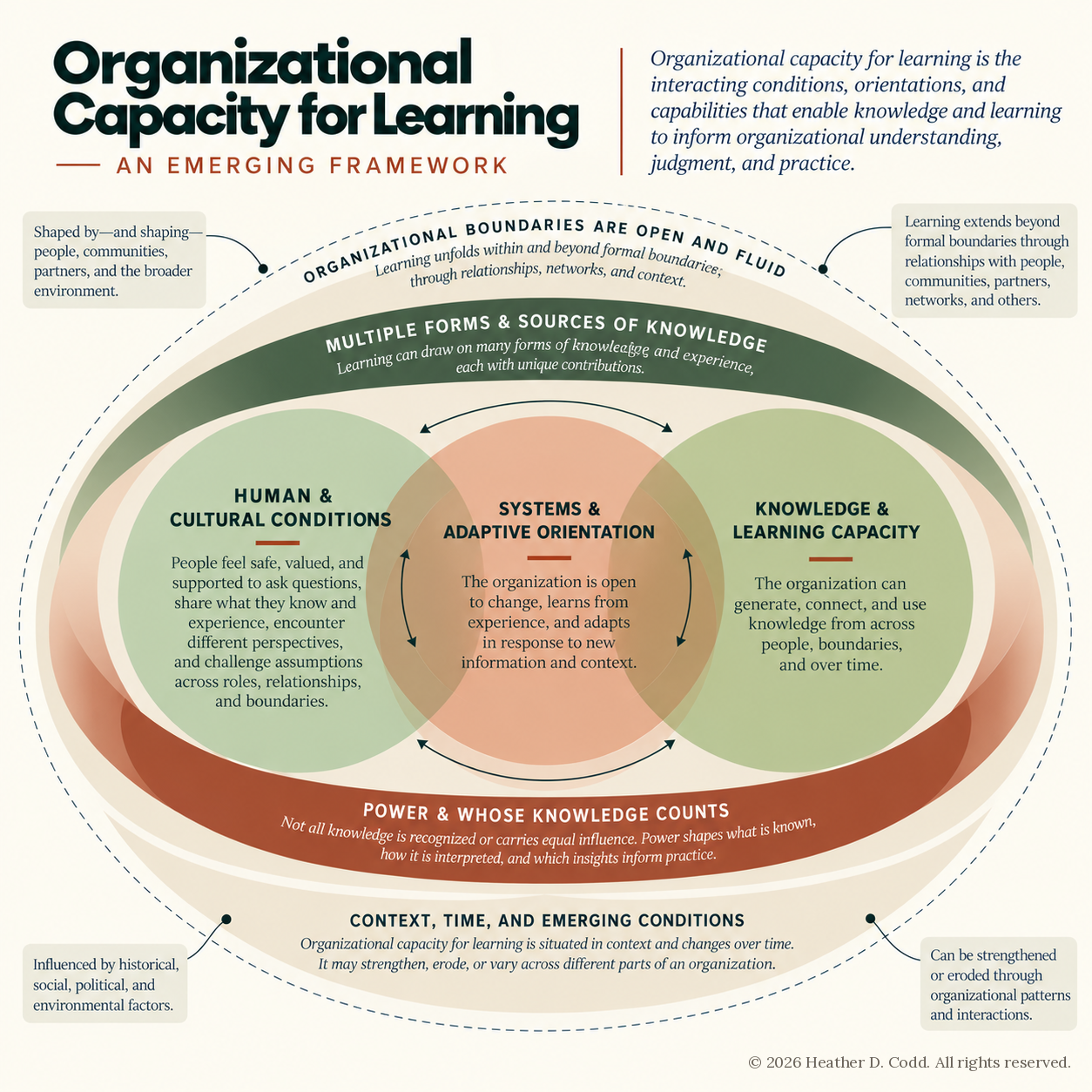
The framework presents organizational capacity for learning as dynamic, interconnected, and situated rather than as a linear process. The three dimensions overlap to reflect their interaction, while multiple forms and sources of knowledge and power and whose knowledge counts cut across them. The open boundary reflects learning that occurs within and beyond formal organizational boundaries, while context, time, and emerging conditions shape—and are shaped by—the organization and its capacity for learning.
Learning is situated
None of this happens in a vacuum. Organizational capacity for learning is situated in context and changes over time. It may strengthen, erode, or vary across different parts of an organization. At the same time, organizational boundaries are open and fluid: organizations learn through relationships with people, communities, partners, networks, and others beyond their formal boundaries. But knowledge that exists within those relationships does not automatically become organizational knowledge simply because the organization has access to it.
A lens for inquiry, not a prescription
This is a working framework. It isn’t intended to prescribe what a “learning organization” should look like or provide a recipe organizations should follow.
Instead, I’m exploring the framework as a lens for inquiry—a way of examining the conditions that shape whether and how organizations are able to learn.
It also leaves me with questions I’m still exploring. When does learning become organizational? How does learning capacity develop and change over time? Where might strong capacity in one part of an organization coexist with constraints elsewhere? For philanthropic organizations, what does it mean for organizational learning when some of the knowledge most important to understanding their work resides outside the foundation—with grantees, communities, partners, and people with lived experience? And what determines whether that knowledge simply reaches the organization or actually has an opportunity to influence what it comes to understand?
More broadly, how might organizations examine and strengthen their own capacity for learning without reducing learning to another checklist of practices to implement?
This framework reflects my current thinking, not its endpoint. I expect it to continue evolving as I engage more deeply with research, test these ideas against practice, and learn from others thinking about these questions.
A few assumptions underlying the framework
As I’ve developed the framework, I’ve found it helpful to make some of its underlying assumptions explicit and to examine them against the organizational learning literature. These assumptions continue to shape how I’m thinking about the framework and its boundaries.
Organizations are not unitary actors. They are composed of people and groups whose interests, intentions, perspectives, and positions may differ, compete, or conflict. These dynamics shape how learning occurs and what knowledge is able to influence organizational understanding and practice.
Learning is not inherently beneficial. What an organization learns may be incomplete, inaccurate, inequitable, or undesirable. Greater capacity for learning should not automatically be equated with better decisions or outcomes.
Learning does not necessarily require consensus or change. Learning may reinforce an existing understanding or course of action, complicate what is understood, surface disagreement or uncertainty, or prompt reconsideration. Different interpretations may continue to coexist.
Organizational learning is multilevel and relational. It is enacted through individuals, groups, relationships, structures, and interactions that may extend beyond formal organizational boundaries. Learning and learning capacity may also be unevenly distributed across an organization rather than universally shared.
Literature that informed this framework
This framework draws on a broader body of scholarship on organizational learning, organizational learning capacity and capability, and evaluation capacity strengthening. The following sources were particularly useful in shaping, challenging, or helping me situate my thinking.
- Bess, K. D., Perkins, D. D., & McCown, D. L. (2011). Testing a measure of organizational learning capacity and readiness for transformational change in human services. Journal of Prevention & Intervention in the Community, 39(1), 35–49. https://doi.org/10.1080/10852352.2011.530164
- Crossan, M. M., Lane, H. W., & White, R. E. (1999). An organizational learning framework: From intuition to institution. Academy of Management Review, 24(3), 522–537. https://doi.org/10.2307/259140
- Lopez, A., Athanasiades, K., Coffman, J., Reid, C., Brothe Gantz, M., & Christopherson, K. (2023). 2023 benchmarking foundation learning & evaluation practices. Center for Evaluation Innovation. https://evaluationinnovation.org/publication/2023-benchmarking-report/
- Nakanishi, Y. (2023). Politics-based knowledge legitimation model: Power exercise in organizational learning. The Learning Organization, 30(3), 273–289. https://doi.org/10.1108/TLO-03-2022-0039
- Preskill, H., & Boyle, S. (2008). A multidisciplinary model of evaluation capacity building. American Journal of Evaluation, 29(4), 443–459. https://doi.org/10.1177/1098214008324182
- Yılmaz Kozcu, G., & Timurcanday Özmen, Ö. N. (2019). Organizational learning capability: A review of empirical research. Dokuz Eylül Üniversitesi İşletme Fakültesi Dergisi, 20(2), 521–535. https://doi.org/10.24889/ifede.631903
Working framework · October 2026
© 2026 Heather D. Codd. All rights reserved.